
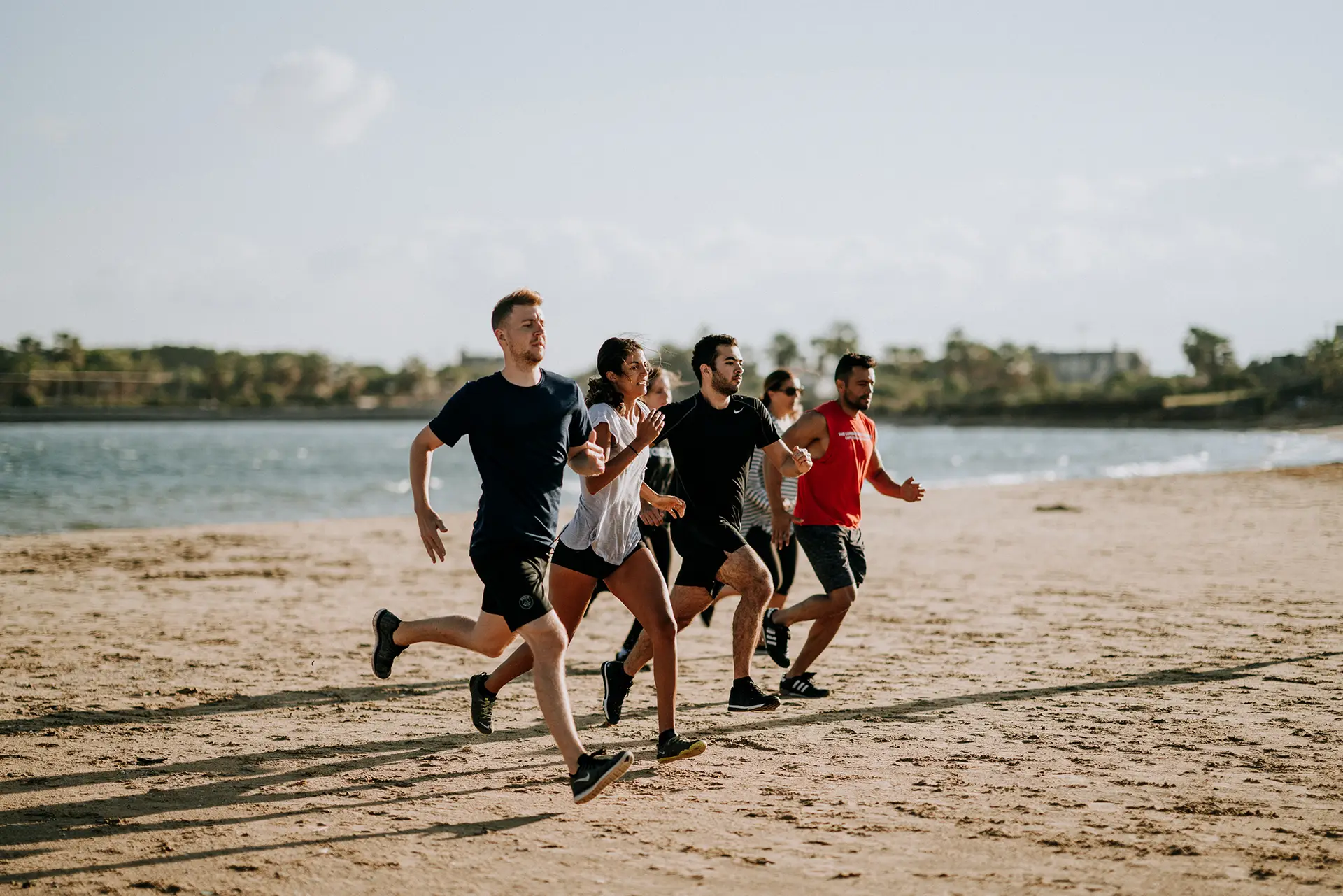
Running is one of the greatest forms of exercise – free, intense and outdoors. Most people think that calf and quads are the most important when running, but strong gluteal muscles are integral for peak performance!
Colloquially referred to as your derriere, tush or bum – your glutes are the largest muscle group in the body, made up of the gluteus maximus, medius and minimus. These muscles help to stabilize your hips and posture, ensuring a strong center of gravity to produce power, speed and acceleration when running. If not strong enough, your running technique will suffer with a drop or shift of the pelvis, placing excess strain on the lower limbs and increasing chance of injury.
So, when stretching before your run, don’t forget about your glutes. And chuck the following exercises into your next workout to start isolating and strengthening your glutes!
1. Single-Leg Deadlift
Standing with hip-width apart, shift weight to one leg and bend at the hips. Reach down to the ground with both arms as your leg swings back, remembering to keep your shoulders back and posture straight. Return to the original position with two feet on the ground and repeat. For greater challenge, hold weights or a medicine ball.
2. Glute Bridge
Start by laying on a flat, comfortable surface. Bend your knees and keep your feet hip-width apart. Your arms will rest by your sides during this exercise. Raise your pelvis off the floor by activating your glutes. Keep your posture neutral so your body forms a straight line, from your neck to your knees. Lower your pelvis to the floor, still activating the gluteal muscles and repeat. For an extra challenge, weights can be held comfortably across the pelvis.
3. Bulgarian Split Squat
Start in a split squat position with your rear foot elevated on a step, bench or chair. Bend the knees to lower the body towards the ground. Be mindful not to move your weight forward as you lower or over extend you back to remain upright.
See the video below for an example:
4. Leg Kickback
Start on all fours, with your hands and knees on the ground. Keep your posture straight and tense your core muscles. Extend one leg upwards, using your glutes to lift the weight of your leg. Your thigh should be parallel to the ground. Return to the starting position, still engaging those gluteal muscles. Swap legs and repeat. Small dumbells can be held behind the knee to add an extra burn.
Whilst these exercises are great to engage your glutes, there are still many more out there. Remember to stretch before and after to prevent injury, as discussed on our website. If there are any concerns regarding pain when running or undertaking gluteal exercises, please consult a physiotherapist or other health clinician. The friendly physiotherapists at Pivotal Motion are here to help! Call us on (07) 3352 5116