
A type of strengthening exercise us physios love to prescribe at Pivotal Motion are isometric exercises. This form of strengthening is often not highlighted enough.
Furthermore, applying it in the injury rehabilitation process can produce significant positive effects. This blog is aimed at providing our readers with the 101 on Isometric Exercises.
What are Isometric Exercises?
When muscle tension/contraction is created but there are no changes in joint positioning or muscular length, we call this isometric exercises. In other words, it’s contracting a muscle without producing any body movements.
What are the benefits of Isometric Exercises?
- They are an excellent starting point for strengthening in the rehabilitation process from an injury. There are plenty of studies that have shown isometric exercises to prevent atrophy (wasting) of muscles in the initial stages of healing.
- They are a great way to isolate specific muscle groups. This contrasts with compound exercises which work a variety of muscle groups together. Individualised strengthening provided by isometric exercises can then in turn improve compound movements.
- They are convenient. Isometric exercises can be done anywhere, any time and often with no need for equipment.
- They can enhance sport performance. In many sports, certain movements produced by one body part require stabilisation from other body parts. A classic example of this is kicking a soccer ball. To kick with your right leg, means that you must stabilise your body with your left leg. The left leg then acts in an isometric manner. A weakness in the left leg will then lead to a break down in the entire movement.
- Reduction of pain levels from certain musculoskeletal injuries. A classic example is tennis elbow which causes pain on the outer part of the elbow and forearm. Research has shown that doing specific isometric exercises for the wrist and elbow are effective in reducing pain levels in tennis elbow. Below is an example.
Examples of Isometric Exercises:
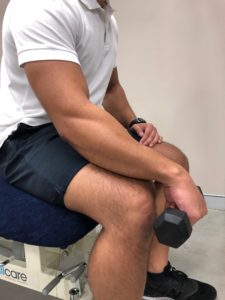
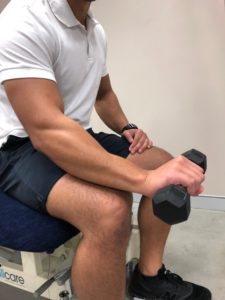
Wrist Extension for treatment of Tennis Elbow:
Purpose: As described above, this is perfect for helping reduce pain levels in tennis elbow. The same concept can be applied to any other tendon issues in the body eg patella tendinopathy, rotator cuff tendinopathy.
Technique: This can be done using a light dumb bell or a theraband. Place your forearm flat on a bench or on your thigh while holding onto the dumbbell or theraband. Have your wrist and hand off the edge of the bench/thigh and hold in this position for 30 seconds.
Core Bracing:
Purpose: Core bracing is important because when applied to activities such as heavy lifting, it can reduce the risk of injuries occurring such as 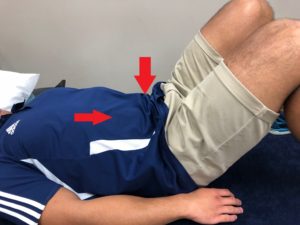 disc bulges and back sprains.
Technique: In crook lying, draw your belly button backwards into the bed while thinking of pulling your ribs down. There should be a contraction in the front abdominal muscles. Hold this for 30 seconds but try not to hold your breath. Once mastered, you can then apply this to every day tasks such as sitting, standing, and transitioning into different positions.
Squat Holds:
Purpose: This is an example of a compound isometric exercise (ie many 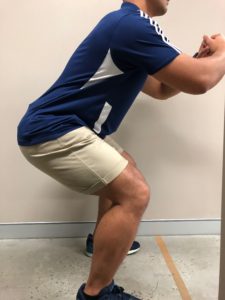 muscle groups working at the same time but in an isometric hold). It is perfect for firing up the glutes and quads following any low back or leg injuries.
Technique: Start with feet shoulder width apart. Unlock the knees while shifting your bottom backwards and hinging forward at the hips. Lower your bottom down as if you are about to take a seat. You may place your hands in front of you for counterbalance.
For more information about isometric exercises, don’t hesitate to see your friendly local physiotherapist at Pivotal Motion. Located in Newmarket, Brisbane. Call us today on 07 3352 5116 or book to visit our exercise physiologist online.