
People are different. This couldn’t be more accurate in the case of a tarsal coalition.
What is a Tarsal Coalition?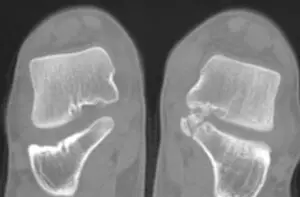
Tarsal coalitions are a variation found in some people where some of the tarsal bones of the foot are fused together.
The tarsal bones are the seven larger bones that make up the back of the foot; behind the toes and the attached metatarsal bones.
Tarsal coalitions, while not impossible, are a quite uncommon condition. They can be genetically inherited and can be found in one or both feet.
HOW are Tarsal Coalitions PRESENTED?
In childhood or adolescence, they usually present as a flat or rigid foot. Pain from the extremity is usually the main symptom and is caused from a restriction of natural movement of the foot.
The two most common tarsal coalitions include:
- Calcaneonavicular Joint – the joint between the calcaneus and the navicular bones.
- Talocalcaneal Joint – the joint between talus and calcaneus bones.
HOW ARE THEY DIAGNOSED?
Specific x-ray views can pick up tarsal coalitions. However, a CT scan is most accurate at identifying the specific location of the coalition.
HOW ARE THEY TREATED?
Tarsal coalitions can be treated in a number of ways. Often a cortisone injection may be enough to settle a painful joint or a Podiatrist can routinely use orthotics and design or recommend a specific type of supportive footwear. Orthotics and footwear are designed to minimise unnatural movement of the joint. Thus, will minimise discomfort and pain.
Some coalitions may still remain problematic, surgical intervention is often an option. This will either include a resection (separation) of the bones, or an arthrodesis (fusion) of the surrounding bones to limit painful movement.
Do you have a potential tarsal coalition injury? Pivotal Motion can assist with tarsal coalitions and the exercise physiotherapy required for healing. Call the physiotherapist Brisbane residents rely on, on 07 3352 5116 or book an appointment online today!