
“I have flat feet!”
Pes Planus is a medical term used to describe a foot that has a flattened arch. There are a number of causes for flat feet and ankle pronation these may include;
- Genetics: Many flat feet are due to some form of genetic predisposition.
- Bony Alignment: It may be that the bony alignment in your foot just sits that way.
- Ligament Mobility: The ligaments within the foot may be more mobile compared to a standard foot, which may cause the foot to collapse.
- Compensating for other issues: The foot may take on that shape to compensate for other issues, such as a leg-length difference, or to get an increased range of motion from tight calves.
- Tendon Rupture/Tear: There could be a weakness, or rupture, of the tibialis posterior tendon. The tibias posterior tendon is an important tendon for maintaining the arch height.
- Bone Fusion: There may be an abnormal fusion of bones inside the foot.
WHAT CAUSES PAIN IN INDIVIDUALS WITH FLAT FEET?
A flat foot on its own does not have to be the cause of pain or injury. It is usually the type of movement that a flat foot is predisposed to that can cause trouble.
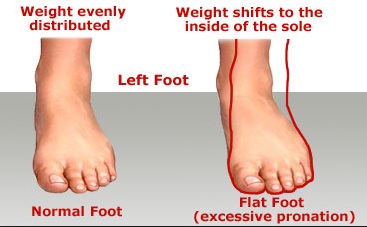
This movement is called pronation. Pronation is a combination of subtle movements that, when viewed in a three-dimensional plane, cause the foot to rotate inward. Located at the joint in the foot below the ankle, known as the subtalar joint.
WHY IS ANKLE PRONATION IMPORTANT?
When walking or running, pronation is important as it provides a method of shock absorption for the body’s force as it comes into contact with the ground. A small amount of pronation is important and healthy. However, if the movement is excessive – which is often seen with flat feet – the force on the supporting structures can increase. The increase in forces can cause damage to these structures.
WHAT OTHER INJURIES ARE ASSOCIATED WITH ANKLE PRONATION?
When the foot pronates, or rolls in, there is tension placed upon the muscles and tissues in the bottom of the foot, and the inside (medial) section of the lower leg. The shin bone (tibia) rotates inwardly, which can change the position of the knee joint. Similarly, the thigh bone (femur) also rotates inward. This causes the hip to tilt down forward and inward.
As a result, excessive pronation movement of the foot can contribute to a wide variety of problems, including bunion development, plantar fasciitis, shin splints, tibialis posterior tendinopathy, knee pain, hip pain, and back pain.
A managed approach to addressing injuries arising from flat feet can massively alleviate pain and get you moving properly again. Whether it be exercise-based recovery prescribed by our exercise physio team, or hands-on physiotherapy treatment, we have a solution for you.
As a physiotherapy Brisbane based clinic, Pivotal Motion can assist with the management of excessive pronation due to flat feet. Call us today on 07 3352 5116 or book an appointment online.