
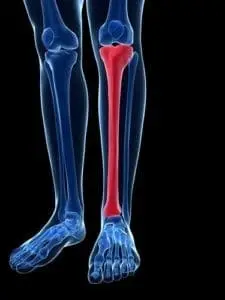
 The phrase ‘shin splints’ is a common term used pain felt anywhere along the shinbone from knee to ankle. Common sites for the pain are either on the upper or lower thirds of the medial tibia and along the front of the tibia. People who play sports that involve a lot of running or jumping are particularly prone to this injury. One of the most common reasons for this discomfort is overtraining or a sudden spike in training, such as trying to exercise beyond your current level of fitness.
Why this happens we are not 100% sure. Recent research suggests it is more likely a precursor to a stress reaction of the bone. The pain is caused by the traction of the muscles that attach to the tibia. Often times when these muscles are weak they are unable to tolerate the load placed through them. If these muscles can’t tolerate the load then they start to pull on their attachment on the bone, which leads to pain.
Pain felt on the inner side of the shinbone is called ‘medial tibial stress syndrome’, while the term ‘anterior shin splints’ refers to pain felt on the outer side.
The symptoms and signs of shin splints can include:
- Aches and pains are felt along the shinbone.
- The area is tender and sore to touch. It can be very focal in location.
- The overlying skin may be red and inflamed.
- The pain may be felt before, during or after running – single leg hopping will reproduce the pain
- Having to stop training (especially running or jumping activities).
Worse case is when a general vibration significantly increases your pain. Shin splints can progress onto bone stress reactions that will require consultation with a physiotherapist or sports doctor to assist with scanning and at times a complete modification of one’s training program.
What causes shin splints
Shin splints can come on from a number of reasons working in combination with the following, shin splints can be exacerbated.
These factors include:
- Overuse – exercising too hard or trying to exercise beyond your current level of fitness can strain muscles, tendons, bones and joints. An overuse injury can also be defined when going from no exercise to even 2-3 times per week. Overuse is one of the most common causes of shin splints.
- Over pronation of the feet. Pronation is a natural part of load absorption from the body. When someone over pronates this creates more stress through the muscles and can lead to injury
- High impact activities – the impact of running on hard or uneven surfaces can injure the shin muscles and tendons.
- Running shoes – wearing the wrong type of shoe or a pair of shoes that are worn out while running can contribute to shin splints.
- A recent change in shoes or environmental conditions such as concrete to grass or vice versa.
- Having decreased range of motion (ROM) at the ankle joint – decreased ROM decreases the bodies ability to absorb force through impact and forces other structures to compensate for the lack of movement at this joint.
How Pivotal Motion Podiatry can assist you with shin splints:
We will complete the following:
- A foot and lower limb biomechanical assessment to assess the cause of shin splints.
- A gait assessment;
- Exercise and activity assessment
- Manual therapy to decrease the pain and increase function
For further reading on Shin Splints, Pivotal Motion Physiotherapy has this blog on the condition: Shin Pain