
Do you know how many bones of the foot there are? Our Brisbane physiotherapists have always found anatomy to be fascinating. When it comes to naming parts of the body, there is (usually) a logical origin to which the various parts received their names.
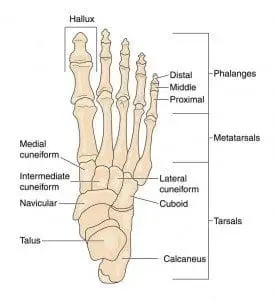
So, what are the bones of the foot?
Following are the names of the bones of the foot, with a translation for the weird and wonderful names that they have.
Feel free to use the image to try to match the name of the bone with their place and shape of the foot.
Tarsal bones – these are the bones closest to the ankle. Each one has a name that translates to describe a little bit about the bone.
- Talus: “Slope made from rock”.
- Calcaneus: “Heel”.
- Navicular: “Boat Shaped”
- Cuneiform: “Wedge Shaped”.
- Cuboid: “Cubic in shape”.
Further along, there are five long bones called “metatarsals”. Also, at the base of the first metatarsal (not seen in this image), there are two small bones called “sesamoids”.
- Metatarsals: “meta- = adjacent” (to the tarsal bones).
- Sesamoid: “Shaped like a sesame seed”.
Finally, each toe is made up of three bones called “phalanges”
- Phalanges: from “phalanx” – infantry formation describing soldiers packed in close together so that their weaponry overlaps.
What to Learn More?
Interested to learn more about the bones of the foot? Our everyday physiotherapy and exercise physiotherapy team love to talk all things anatomy; So, get in touch with us on 07 3352 5116 or book online today and we’ll help get you moving again so you can live your life to the fullest.
Updated 12/03/2021