This article is educational and is not personal medical advice.
Pain, injury and rehabilitation are individual. A Pivotal Motion physiotherapist can assess your
specific symptoms and recommend treatment. To book a consultation, visit
pivotalmotion.physio
or call (07) 3352 5116.
Disclosure:
This post contains affiliate links.
As an Amazon Associate, Pivotal Motion Education earns from qualifying purchases.
There is no additional cost to you.
See our Affiliate Disclosure.
A shoulder brace can make a sore shoulder easier to manage through the day. However, what it will not do is mend a rotator cuff tear, even if the product description states otherwise. Rotator cuff injuries have to be professionally evaluated by a physiotherapist or a GP, and graded exercise rehabilitation does the recovery work.
The brace plays a lesser part. Compression and warmth may assist with shoulder pain, and a little more support will make it easier by limiting the shoulder movement that aggravates the injured area.
Pivotal Motion has been treating shoulder injuries in Newmarket since 2009. We have ranked these braces by considering what you would actually experience when the brace is put on: the fit, the support that it offers, comfort levels after hours of use, and whether getting it on is a hassle. If the injury itself is your main concern, start with a rotator cuff assessment.
How we chose these shoulder braces
Support level is the first thing we looked at. A lightweight compression sleeve or bandage provides warmth and support, which is sufficient for everyday use. But if you are active and require additional control over your shoulder movement, then an adjustable stabiliser strap is the better choice.
The moment anything goes to immobiliser or sling territory, things change. This one needs to go to your treating physio, especially for post operative cases. The options here are wearable shoulder supports, not medical immobilisation gear.
The next topic was fit. We considered adjustable straps, sized versus universal designs, the real size range available, and the bulkiness of each brace when worn under a shirt. Comfort is just as important after the brace has been worn for a few hours. Anything that rubs or retains heat in the Brisbane summer is unlikely to be used very often.
There is also the question of practicality: Is it possible to wear it with just one hand when the other shoulder is sore? Lastly, we considered the value and if it was available on Amazon AU.
One thing we didn’t assess was whether these compression braces change how a rotator cuff heals. Because they don’t. While some product descriptions may claim to offer superior support or even to speed up the healing process, the reality is that a brace is not what delivers rotator cuff recovery. What we could judge was much simpler: comfort, fit and the quality of the support you get while wearing it.
The best shoulder braces for rotator cuff support in Australia at a glance
Five shoulder supports, each for a different job.
BraceUP Shoulder Brace: Best overall
Features at a glance
| Type | Shoulder compression wrap |
|---|
| Support level | Moderate, adjustable |
|---|
| Key features | Chest and bicep straps, repositionable pad, pocket for a hot or cold pack (not included) |
|---|
| Fit | One size, chest 76 to 127cm, upper arm 25 to 36cm, left or right |
|---|
| Best for | Adjustable everyday support at home and work |
|---|
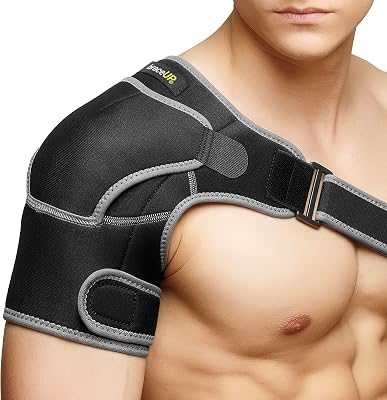
Buy now on AmazonMost people searching for the best shoulder brace want something they can adjust properly at home, without needing a fitting appointment. This one makes it quite easy. It features two adjustable straps that attach the brace to your chest and bicep. In addition to that, the pressure pad is adjustable to the place where your pain lies.
It also works on either shoulder. Inside is a fairly large pocket, around 15.5 by 17 centimetres, with room for a standard hot or cold pack. Handy if cold therapy is part of your routine after activity, although you’ll need to supply the pack yourself.
It’s a one-size design, made for an upper-arm circumference of 25 to 36 cm (about 10 to 14 inches) and a chest of 76 to 127 cm. The fabric is soft and breathable too, rather than the thick neoprene you get with some shoulder supports. That becomes important if you’re wearing it for most of a workday.
This would suit anyone who wants targeted compression over a sore spot but still wants some control over the fit. The adjustable straps can be loosened as the day goes on if the shoulder starts to feel uncomfortable. It’s currently the top seller in its category on Amazon Australia.
The one size design is the compromise. If you have a particularly large or slight frame, the fit won’t be as precise as you’d get from a sized shoulder brace. And while the strap-and-pad design is useful for comfort, it won’t give you the same control if shoulder instability is the bigger problem.
Physio verdict: The safest first buy for most people. Measure your bicep before ordering, then spend some time getting the pressure pad in the right spot. Pulling the straps tighter won’t necessarily give you proper shoulder support.
Check price on Amazon AU: BraceUP Shoulder Brace
Shock Doctor Shoulder Support: Best for return to sport
Features at a glance
| Type | Shoulder stability brace |
|---|
| Support level | Medium stability |
|---|
| Key features | Multi-position X-Fit stabiliser strap, chest-wrap straps, stretch mesh with Lycra binding |
|---|
| Fit | Fits left or right shoulder, check the size chart |
|---|
| Best for | A graded return to training and sport |
|---|
Buy now on AmazonThis is the one to look at if you’re heading back to training. The 842 uses an X-Fit stability strap with several anchor points, giving you some say over how much shoulder movement you allow rather than simply making the brace tighter. Chest-wrap straps keep it in place, while the neoprene is vented and moisture-wicking. Stretch mesh panels with Lycra-bound edges give a little as you move, too. Shock Doctor puts it at performance level 3, meaning medium stability for moderate ligament sprains and muscle strains. It can be worn on either shoulder.
This is ideal for athletes recovering from shoulder injuries who are now ready to start working out again. It is particularly good for overhead athletes and people who are getting back into contact sport. The extra resistance gives the shoulder something to work against, which can help with confidence when you return to lifting weights after time out.
But there is a drawback to that additional stiffness. Wear it for eight hours in an office chair, and it will start to feel like a harness rather than a shoulder brace. For everyday wear, it is likely too stiff for most people.
Physio verdict: A solid support for a graded return to sport, but just because you wear it does not mean that you are ready to return. It is not going to stop you from getting injured either. That is where the rehab and loading come into play, so keep shoulder physiotherapy sessions going alongside it.
Check price on Amazon AU: Shock Doctor Shoulder Support
McDavid Shoulder Wrap: Best for easy one-handed fitting
Features at a glance
| Type | Light neoprene shoulder wrap |
|---|
| Support level | Light |
|---|
| Key features | Hook-and-loop straps, compression over the AC joint, latex-free neoprene |
|---|
| Fit | Fits left or right shoulder, no buckles to thread |
|---|
| Best for | Easy fitting and comfortable all-day wear |
|---|
Buy now on AmazonGetting a brace onto a painful shoulder can be half the battle. The 463 is the least fiddly option here because McDavid has done away with buckles completely. Hook-and-loop straps hold the brace around the latex-free neoprene and put compression directly on the AC joint. There is nothing that you have to thread into a buckle or clip into place while working around a sore arm. The 463 brace fits both sides, with sizing based on your chest measurement.
McDavid rates it level 1, and it’s an appropriate assessment of what you’ll be getting. This is general support for your shoulder pain and stiffness; it is not a brace for restricted movement after a specific injury. The benefit is that it’s much more comfortable for constant wear across a workday.
This one would be ideal for older individuals or those who find it difficult to stretch across to their sore side, or even those who need to dress themselves without assistance. It is also an appropriate choice for a frozen shoulder where warmth and lightness are of greater importance than restricted movement.
The trade-off is control. Without the use of a stabiliser strap system, the brace functions more to provide compression and warmth than to restrict the arm from certain angles. This works well when dealing with pain and stiffness, but not when it comes to shoulder instability.
Physio verdict: The one to buy when getting a brace on is the difficult part. If you need more than compression and want the shoulder held with controlled movement, step up to an adjustable stabiliser.
Check price on Amazon AU: McDavid Shoulder Wrap
FIGHTECH Shoulder Brace: Best for adjustable compression
Features at a glance
| Type | Neoprene shoulder compression wrap |
|---|
| Support level | Firm, adjustable |
|---|
| Key features | Adjustable hook-and-loop straps, pressure pad that holds a hot or cold pack |
|---|
| Fit | Left or right, S/M fits arm 11 to 16 inches and chest 33 to 50 inches |
|---|
| Best for | Adjustable compression for daily wear and light activity |
|---|
Buy now on AmazonThis brace turns up everywhere when you search for support for a torn rotator cuff, largely because of the strap setup. The strong and adjustable straps keep the neoprene wrap in place, but also allow you to put targeted pressure on the sore spot. If at some point it feels like too much pressure, it can be easily adjusted.
Instead of one size fits all, there are four different sizes available. It can be worn on either shoulder, and the current design includes an inside pocket to place hot or cold packs inside, which is useful if cold therapy is part of your routine.
Do not use your usual shirt sizing when placing your order. This one relies on the measurement of your arm and chest sizes. As an example, a Small/Medium will fit someone whose arm size measures between 11 and 16 inches.
This would suit anyone after a firmer, more secure shoulder support brace for daily wear or light activity. It’s particularly for anyone who requires compression that can be adjusted according to their needs throughout the day.
The downside is bulk. This shoulder brace will be visible when wearing it under a work shirt, and in addition, it becomes quite hot after a couple of hours. Also, even though some online product descriptions claim otherwise, controlled compression does not help protect healing tissues. Think of this as a comfort and support tool, not something that changes the healing process.
Physio verdict: The most adjustable option here for controlled compression. Just be sure to compare the sizing chart with your arm size prior to purchase.
Check price on Amazon AU: FIGHTECH Shoulder Brace
COPPER HEAL Shoulder Brace: Best budget-friendly support
Features at a glance
| Type | Adjustable shoulder compression sleeve |
|---|
| Support level | Light |
|---|
| Key features | Copper-infused nylon and spandex blend, adjustable straps, lightweight |
|---|
| Fit | Unisex, fits left or right shoulder |
|---|
| Care | Hand wash in cold water and air dry |
|---|
Buy now on AmazonThis is a cost-effective option to consider if you aren’t sure whether a shoulder brace will work for your needs. This is an adjustable shoulder compression sleeve that has straps running across the front and back, yet the material stays fairly light and flexible.
This makes it more comfortable to wear for extended periods of time, and it lies underneath your clothing without the added weight of the bulky neoprene strap. This brace is unisex and can be worn on either shoulder. There is also a pressure pad included for the strap.
Don’t buy into the copper hype. Yes, there are copper-infused fibres in the material, but there is no research that shows any benefit to copper in clothing when it comes to shoulder pain relief. What you’re getting here is compression, a good strap design, and a comfortable brace.
This is a reasonable first shoulder brace, especially for minor shoulder pain where you require some support but don’t need something bulky. Its design is more about everyday comfort than restricted movement.
Support is fairly basic. It adds compression and stays in place, but that’s about as far as it goes. If you need controlled movement or more support for shoulder instability, it’s worth spending more on a sturdier shoulder brace.
Physio verdict: A sensible, low-cost way to find out whether compression makes the shoulder feel more comfortable. It makes a good first shoulder brace if comfort is the goal. For shoulder instability, though, you’ll need more support.
Check price on Amazon AU: COPPER HEAL Shoulder Brace
How to choose the right shoulder brace for you
Start with how much movement you want restricted, not with the brand. Want warmth and light compression to get through the day? A neoprene sleeve or wrap does that. If you need more control over movement so you can train, look for an adjustable stabiliser strap.
If you’ve been told to immobilise your shoulder after surgery, you are facing a totally different challenge. The sling or the immobiliser must be prescribed and put on by the doctor who is treating you; immobilisation cannot be self-taught from a web page.
Then think about what your day actually entails. When it comes to desk work or wearing for extended periods during the day, a less supportive shoulder brace is generally the way to go. This does not apply to the gradual return to sport, especially with the introduction of progressive loading. That’s where firmer support and adjustable straps can be useful.
Sleeping is easier. Just use your most comfortable cushion, or no cushion at all if you don’t need one. Many people who have pain in their shoulder find it easier to sleep in a reclining chair for a few weeks instead.
Fit makes or breaks a shoulder brace. You cannot assume the sizing will be similar to clothing sizes; get the measurement that the manufacturer requires. Even among the brands we’ve chosen, there is no uniformity. BraceUP requires bicep circumference, FIGHTECH requires arm and chest circumference, while McDavid requires chest circumference. Measure incorrectly, and the brace will either pinch or slip. Either way, it will not be comfortable to use.
How to fit and use a shoulder brace safely
Refer to the sizing chart and not your normal shirt size, then take some time to place the pressure pad in the affected area instead of simply placing it on the shoulder.
The straps should be snug, but don’t keep tightening them in search of more support. Numbness, tingling down the arm, pins and needles in your hand or a change in finger colour all mean you’ve gone too far. Loosen the brace and reset it.
Wear time is where people often come unstuck. A shoulder brace is there for the parts of the day when you need some extra support, not necessarily from morning to night. Too much constant wear can also mean the rotator cuff muscles do less of the stabilising work themselves.
If the brace is needed for activities that cause discomfort to your shoulder, use it during those times and remove it when you do not require it. Physical therapy exercises will always be more important. That’s where progressive loading comes in, gradually building strength and helping restore function rather than leaving you reliant on the brace.
Skin is easy to forget about. Neoprene holds onto heat and sweat, and in a Queensland summer, that can quickly irritate the affected area. Keep the skin dry and give the injured area a break from the brace every so often. Check your skin when you take it off, too. Pressure sores aren’t common with a soft wrap, but they can happen if the brace is too tight and stays on for hours.
Some symptoms need an assessment before you start relying on a shoulder brace. If you experience weakness, an inability to lift your arm, pain following a fall or injury, a dislocated shoulder, or numbness going down the arm, then you need to see a doctor. The same applies if your shoulder pain is getting worse rather than settling.
These symptoms should be handled by a healthcare professional, not a shopping cart. If left untreated, an unstable shoulder or one that cannot be lifted could prove more difficult to deal with. Book a physiotherapy assessment rather than guessing what the injury needs.
Do shoulder braces work for a rotator cuff injury?
A brace can make the shoulder feel more comfortable and supported, especially when some shoulder movement keeps triggering the pain. This can be handy for daily activities. For general use and even a little more reassurance while using the injured shoulder, many people find a shoulder support brace most helpful.
What a brace can’t do is repair torn tissue. The rotator cuff muscles start at the shoulder blade and end at the top of the humerus (the upper arm bone), which is below any area that a wrap would cover. It doesn’t matter whether it’s a partial tear or a complete tear, the brace isn’t what causes rotator cuff recovery. Graded exercise and progressive loading do the real work.
That is why conservative treatment begins with physical therapy, which can take weeks or even months. If your symptoms persist, your doctor will discuss other treatment modalities such as corticosteroid injections or surgical repair. Such decisions are based on your specific injury and must be made by someone who has personally examined your shoulder.