This article is educational and is not personal medical advice.
Pain, injury and rehabilitation are individual. A Pivotal Motion physiotherapist can assess your
specific symptoms and recommend treatment. To book a consultation, visit
pivotalmotion.physio
or call (07) 3352 5116.
Disclosure:
This post contains affiliate links.
As an Amazon Associate, Pivotal Motion Education earns from qualifying purchases.
There is no additional cost to you.
See our Affiliate Disclosure.
The best tennis elbow brace for most people is a strap or sleeve that puts firm pressure on the forearm muscle during the jobs that hurt: gripping a kettle, lifting shopping bags, working a mouse or hitting a backhand. Tennis elbow (lateral epicondylitis) shows up as pain on the outside of the elbow, and Pivotal Motion physios in Newmarket, Brisbane fit elbow straps and sleeves for clients. The picks below are ranked the way we fit them in the clinic.
Set your expectations first. A brace may reduce strain on the tendon while you work or play, which can make those tasks easier to get through. Exercise is what builds the tendon’s capacity over time.
How we chose these tennis elbow braces
We started with brace type. A counterforce strap wraps the upper forearm, a compression sleeve covers the whole elbow joint, and some sleeves add a built-in pad that does part of a strap’s job.
The pressure pad came next, because it is the point of a tennis elbow strap. A firm compression pad sitting over the forearm extensor muscles gathers the strap’s force into a small area for targeted support, instead of spreading it around the arm.
You will usually be fitting the brace with the sore arm doing half the work, so we scored one-hand tensioning highly. Velcro straps and Mueller’s pull pocket both make that easy.
Thermoskin’s listing gives no sizing detail beyond one size, while Bauerfeind and CAMBIVO publish a sizing chart. Brands with a chart ranked higher, because a loose strap slides down the arm and a tight one pinches.
Comfort over long periods counts in Brisbane. Knit fabric breathes better than neoprene in a humid summer, and soft edges stop a brace digging in after an hour at the keyboard. We also checked whether the pad can be turned to the inside of the forearm for golfer’s elbow, and we included Australian brand Thermoskin.
The best tennis elbow braces in Australia at a glance
Here is the short version of the best tennis elbow brace picks, with prices and ratings to confirm on Amazon AU on the day you buy.
Bauerfeind EpiTrain Elbow Support: Best overall
Features at a glance
| Type | Knitted compression elbow support |
|---|
| Key features | Built-in pads over the forearm tendons, softer elastic edges that do not cut in |
|---|
| Fit | Sized by forearm circumference 12 cm below the elbow, bent to 90 degrees |
|---|
| Best for | Several hours of wear for tennis or golfer's elbow |
|---|
| Made in | Germany |
|---|
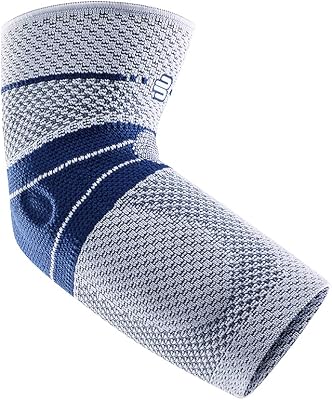
Buy now on AmazonThe EpiTrain is a knitted compression elbow support made in Germany, with built-in visco-elastic pads that sit over the forearm tendons during movement. It gives you a sleeve’s even compression and the pad pressure of a strap in one piece.
The knit is the reason it wins. It is softer and more breathable than neoprene, and Bauerfeind makes the fabric softer and more elastic at the edges so the support does not cut in or slide down. That suits a long day at a desk or a morning in the garden, and it covers golfer’s elbow as well as tennis elbow.
Measure before you order. Bend your elbow to 90 degrees, measure 12 cm down from the elbow towards your hand, and take your forearm circumference at that point. Bauerfeind’s sizing chart is built on that one measurement.
This brace suits people with ongoing elbow pain who wear a brace for several hours a day. The catch is cost: it is the most expensive pick here, and if you fall between two sizes the fit can feel either loose or tight.
Physio verdict: the most comfortable option for all-day wear, with pad placement already built in.
Bauerfeind EpiTrain Elbow Support
Mueller HG80 Premium Tennis Elbow Brace: Best counterforce strap
Features at a glance
| Type | Counterforce forearm strap |
|---|
| Key features | Soft gel pad, pull pocket for one-handed tensioning, soft fabric tab |
|---|
| Fit | Small/Medium and Large/X-Large, the Amazon AU link is Small/Medium |
|---|
| Best for | Tennis, tool work and other specific tasks |
|---|
Buy now on AmazonThe HG80 is a classic counterforce strap. It wraps the upper forearm, and a soft gel pad concentrates the strap force over the extensor muscle where you need it.
Two small details make it easy to live with. There is a pull pocket at the end of the strap, so you can hook a finger in, place it and set the tension with one hand, and the adjustment tab is soft fabric rather than a hard edge. The materials are neoprene-free and latex-free, and the strap is thin enough for a comfortable fit under a work shirt or on court.
It comes in Small/Medium and Large/X-Large. The Small/Medium listing covers forearms of 17 to 27 cm, so check your measurement against the chart before you pick a size.
The HG80 suits people whose pain comes on during specific tasks such as tennis or using tools. Its limitation is the same as any strap: it only helps when it sits in the right spot, and pulling it too tight can bring on pins and needles in the hand.
Physio verdict: a counterforce strap is the type of brace Pivotal Motion physios fit most often for tennis elbow, and this gel pad stays comfortable with repeated use.
Mueller HG80 Premium Tennis Elbow Brace
Push Sports Elbow Brace: Best for gripping and manual work
Features at a glance
| Type | Slimline elbow strap with shaped pad |
|---|
| Key features | Adjustable pressure, fits with one hand, washable |
|---|
| Fit | One size |
|---|
| Best for | Strapping up before lifting, gripping or tool work |
|---|
| Placement | Outer forearm for tennis elbow, inner forearm for golfer's elbow |
|---|
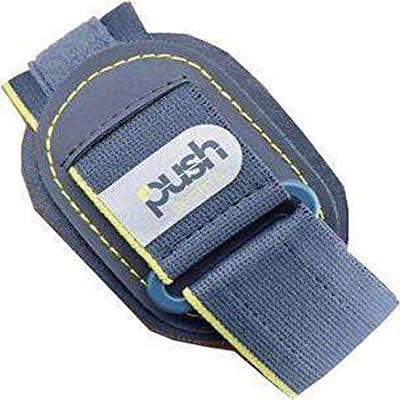
Buy now on AmazonThe Push Sports brace is a slimline strap with an anatomically shaped pad and pressure you adjust yourself. It is built for people who take a brace on and off through a work day.
You can fit it with one hand, which matters when the sore arm is the one you would normally strap with. Push prints clear fitting steps. The yellow pad goes on the outside of the forearm for tennis elbow or the inside for golfer’s elbow, about six centimetres below the elbow, with the strap ring kept out of the elbow crease. You should feel pressure when you bend the arm and tighten the muscles, and no tension when the arm relaxes.
It is washable and works on either arm. Tradies and gardeners who strap up before a block of lifting or tool work are the best fit, and so are gym users who only want it on for heavy sets.
The downside is that it is sold as one size on Amazon AU, which may not suit very small or very large forearms, and it costs more than a generic strap.
Physio verdict: a well-made strap that stays in place during heavy gripping.
Push Sports Elbow Brace
Neo G Tennis/Golf Elbow Support Strap: Best for golfer’s elbow
Features at a glance
| Type | Neoprene elbow strap |
|---|
| Key features | Built-in dampening pad, adjustable compression |
|---|
| Fit | One size, left or right arm |
|---|
| Best for | Golfer's or tennis elbow, with the pad turned to the sore side |
|---|
Buy now on AmazonThe Neo G is a neoprene strap with a built-in dampening pad and adjustable compression. It is one size, fits the left or right arm, and the pad can go over the inner forearm for golfer’s elbow or the outer forearm for tennis elbow.
Golfer’s elbow (medial epicondylitis) is the same type of tendon problem on the inside of the elbow, where the forearm flexor tendons attach to the bony point called the medial condyle. Because the cause is similar, the same strap works once you turn the pad inward.
This one suits golfers and climbers, along with anyone who carries heavy loads through the day. If you throw or play overhead sport, pain on the inside of the elbow can have other causes, so read our clinic page on throwing-related elbow pain before you assume a strap is the answer.
The catch is the neoprene. It gets warm in Brisbane humidity, and it can feel bulky under a fitted shirt.
Physio verdict: a simple, adjustable strap that works for both sides of the elbow.
Neo G Tennis/Golf Elbow Support Strap
Thermoskin Sport Tennis Elbow Strap: Best budget strap
Features at a glance
| Type | Basic counterforce strap |
|---|
| Key features | Tendon pad for localised compression, adjustable closure |
|---|
| Fit | One size |
|---|
| Best for | A low-cost trial of a strap during aggravating tasks |
|---|
Buy now on AmazonThermoskin is an Australian brand based in Kilsyth, Victoria, and this one-size strap is a low-cost way to find out whether a counterforce strap helps you.
It has a tendon pad for localised compression and an adjustable closure. That is all the listing says, and that is roughly all you are getting: a pad and a strap, without the gel liner of the Mueller or the shaped pad of the Push.
That plain design is the point. Wear it during weekend tennis or a day of gardening, and if the task feels easier with it on, you know a strap is worth upgrading. If it makes no difference, you have not spent much to learn that.
The limitation is the simpler pad and strap, plus a short product listing with no sizing detail beyond one size.
Physio verdict: a sensible low-cost way to find out whether a strap helps during your aggravating tasks.
Thermoskin Sport Tennis Elbow Strap
CAMBIVO Elbow Brace 2 Pack: Best value compression sleeve
Features at a glance
| Type | Knitted elbow compression sleeves, 2 pack |
|---|
| Key features | Silicone pad around the elbow, stabilisers on the inner and outer sides |
|---|
| Fit | Small to X-Large, snug, measure against the chart |
|---|
| Best for | General elbow support at the gym, or for both elbows |
|---|
Buy now on AmazonThe CAMBIVO pack gives you two knitted compression sleeves, each with a silicone pad around the elbow and stabilisers on the inner and outer sides. It is the pick for people who prefer an elbow compression sleeve, or who want one for each arm.
A sleeve does a different job from a strap. It wraps the whole elbow joint in even compression and warmth, rather than pressing on one spot on the forearm, so it suits people who find a strap too firm or want general elbow support at the gym. Weightlifters and people with pain in both elbows get the most from the two pack.
It comes in Small to X-Large with a sizing chart. CAMBIVO’s own listing notes that sizing can vary with arm shape and personal preference, so measure carefully and expect a snug fit.
The limitation is the one every sleeve has: it does not concentrate pressure over the forearm muscle the way a strap does.
Physio verdict: good value if you prefer a sleeve, but try a strap first if your pain is mainly with gripping.
CAMBIVO Elbow Brace 2 Pack
Strap or sleeve: how to choose the right tennis elbow brace
Choose a strap if your pain comes on with specific tasks. Gripping, lifting, racquet sports and long stretches of mouse work all load the forearm muscles, and a tennis elbow strap pushes on those muscles 2 to 3 finger widths below the elbow.
Choose an elbow compression sleeve if you want general compression and warmth around the joint for long periods, or if a strap feels too firm on your arm. If you want both, a sleeve with built-in pads like the EpiTrain covers each job.
Budget changes the order. We’d suggest starting with a low-cost strap such as the Thermoskin to test whether bracing helps at all, then spending more on a strap or sleeve you will wear daily.
Your day matters too. Desk workers do best with a slim strap that sits under a shirt sleeve without bunching. Tennis players and golfers need a strap that will not slide down the arm mid-swing, and the Push strap is our pick for heavy gripping. For golfer’s elbow, pick a strap whose pad you can turn to the inside of the forearm, like the Neo G or Push.
How to fit and wear a tennis elbow strap
Where the strap sits decides whether it does anything. Bend your elbow and find the bony point on the outside. Measure 2 to 3 finger widths down your forearm from there and place the pad over the thick forearm muscle, not on the bone and not in the elbow crease.
Too tight is the common mistake. Aim for firm when you make a fist and loose enough to slide a finger under. If your hand tingles, goes numb, changes colour or feels cold, the strap is pressing on blood flow, so loosen it straight away.
Grab a soft tape measure before you order. Each brand picks its own measuring point (Bauerfeind’s is 12 cm down from a bent elbow), and a reading taken at the wrong spot can put you a size out.
Put it on before the gardening and take it off when you come inside. The same goes for a tennis session or an afternoon on the mouse. So how many hours a day should you wear a tennis elbow brace? As long as the aggravating task lasts, not all day. Leave a counterforce strap off overnight unless your physio has said otherwise.
If you wear neoprene, check your skin for redness or rubbing at the end of the day. This is general guidance only, and your physio can check placement on your own arm.
Do tennis elbow braces actually work?
For some people a brace may give some pain relief and reduce strain during activity, enough to get through a shift or a tennis set. The tendon itself still needs loading to recover, and a brace does not heal tendinopathy (the term physios now use for what used to be called tendonitis).
Recovery is slow. Healthdirect, the Australian Government health information service, gives 6 to 12 months, and says a physio may recommend a forearm brace or strap to reduce stress on the painful area alongside exercise. Physios usually start with isometric exercises, where you hold a grip or wrist position without moving, then progress to slow forearm and grip strengthening as the tendon tolerates more load. Pivotal Motion’s experience is that most people recover well with this conservative approach, and a physio for elbow pain can assess your arm and set the plan.
See a physio or GP rather than buying a brace if you have symptoms such as elbow swelling with heat or fever, numbness or tingling into the fingers, pain after a fall or a visible deformity, or pain that keeps getting worse despite rest.