This article is educational and is not personal medical advice.
Pain, injury and rehabilitation are individual. A Pivotal Motion physiotherapist can assess your
specific symptoms and recommend treatment. To book a consultation, visit
pivotalmotion.physio
or call (07) 3352 5116.
Disclosure:
This post contains affiliate links.
As an Amazon Associate, Pivotal Motion Education earns from qualifying purchases.
There is no additional cost to you.
See our Affiliate Disclosure.
A back support belt wraps firmly around the lower back, adding compression and warmth when you need it. For some people, that little bit of extra support also makes it easier to keep better posture while getting through a job that would normally aggravate their back pain.
That’s what these belts are for. They can make some activities feel more comfortable and supported, but they will not fix the cause of your pain. That’s why we have screened through the list of choices available and organised them based on how they can be used, rather than just their price. If your lower back pain is severe or just won’t settle, don’t start with a belt. Get the cause checked first with physiotherapy for lower back pain.
How we chose these back support belts
We started with how much structure each brace actually gives you. A basic elastic support belt is designed to put pressure on the area and keep it warm, while still allowing you complete mobility. This can be enough for light use. Semi-rigid braces take it to the next level by incorporating plastic stays or splints to provide back support.
Rigid braces limit movements further and help to stabilise the trunk. The right choice of brace will depend on the activity being performed. Heavier work would require greater stability, while long hours sitting at a desk usually don’t.
Next came fit. The range of sizes and the level of control that can be achieved through the use of the adjustable straps were evaluated, as well as whether a second pull would be needed in order to create more pressure. A lumbar pad might offer additional support, but this would only be possible if the belt stays in place.
Next up, comfort. Comfort is just as essential, particularly when you’re planning on wearing your belt for hours at a time. We made sure to look for breathable materials, but we also thought about a few other factors, such as how bulky the belt was going to be under your clothes, how abrasive it was going to be, and how quickly it was going to warm up. You may have great support in theory, but it won’t work if it gets sweaty and falls off at lunchtime.
Practicality was the last test. Are you able to fit yourself in the brace with no help, ensure that it fits you well, and then take it off with ease? We also took into account whether there is value for money. A more expensive back brace must offer something useful.
All selections are available on Amazon Australia. We tested the support, fit, and comfort features of all these belts, but we have not performed any tests for any medical results and make no treatment claims.
The best back support belts in Australia at a glance
Seven picks, each chosen for a different job. Find the back support you need based on when and why you’ll actually wear it.
Mueller 255 Lumbar Support Back Brace: Best overall
Features at a glance
| Type | Semi-rigid lumbar back brace |
|---|
| Support level | Moderate, suited to everyday and light activity |
|---|
| Key features | Removable lumbar pad, double-layer design, breathable fabric |
|---|
| Fit | Adjustable compression from the double layer and outer straps |
|---|
| Best for | Everyday lumbar support during chores or long periods of sitting |
|---|
Buy now on AmazonFor most people, this is the lumbar back brace we’d recommend starting with. This brace is semi-rigid and features a removable pad placed over the lower back area, as well as two outer adjustable straps. You just have to pull these straps over once you’ve adjusted the main belt.
There’s also a moulded plastic section inside the brace to prevent any rolling and bunching during movement. This is a common problem associated with conventional lower back braces, particularly after prolonged wear. The standard size is suitable for waist measurements ranging from 71cm to 127cm, and the breathable fabric makes it more practical.
This is the best one for daily back support, whether you are doing household chores or dealing with prolonged sitting. The level of support provided by this brace is adequate for light activity, and it doesn’t feel excessive. This brace does not suit the upper back, however, and we’d look elsewhere if heavy lifting is the reason you need one.
The only drawback is that it can become quite warm, particularly after long hours of wear. The brace also contains natural rubber latex and neoprene materials, so it might not be suitable for people who have sensitivity to these materials.
Physio verdict: It is a good default choice if you need lumbar support and some added comfort. It does what you want without trying to pass off as a remedy for lower back pain.
Check price on Amazon AU: Mueller 255 Lumbar Support Back Brace
Paskyee Back Brace for Lower Back Pain: Best value
Features at a glance
| Type | Compression back brace with support stays |
|---|
| Support level | Moderate compression |
|---|
| Key features | Six support stays, breathable mesh panels, adjustable fit |
|---|
| Fit | Sized by waist measurement, slim enough to wear under clothing |
|---|
| Best for | Everyday compression on a budget |
|---|
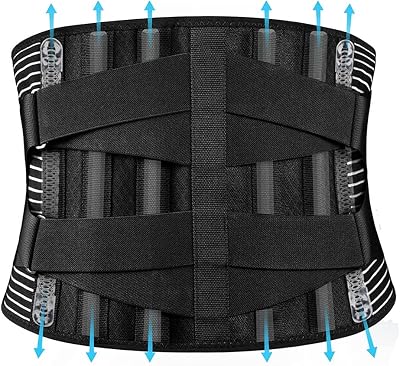
Buy now on AmazonGreat compression at a great price. With the adjustable straps, you can decide how tight it is going to be, and the lumbar pad will give you the additional support you need. The vertical supports also ensure that the support belt maintains its shape and does not roll up every time you bend.
The breathable fabric is fairly discreet under a shirt, which helps if you’re planning to wear it during the day. There’s a broad size range available, but measure your waist before ordering rather than guessing.
A sensible first support belt to use if you haven’t worn a support belt before. It’s simple enough to wear for normal work and prolonged sitting without providing any unnecessary structure.
There are two things worth pointing out. This back brace is designed with compression, not with rigid support in mind, so its primary benefits are comfort and posture training. It is not the back brace we would recommend if you require additional support for heavier loads.
Disc herniation and sciatica are also mentioned in the product description, like many braces. This is only marketing language; there is no proof that the belt can help in treating this kind of pain or any of the symptoms associated with them.
Physio verdict: Good value if you want some back support and comfort while you’re active. Just don’t buy it expecting the belt itself to provide pain relief or fix what’s causing the pain.
Check price on Amazon AU: Paskyee Back Brace
Back Support Brace with 6 Stays: Best budget
Features at a glance
| Type | Elastic lumbar support belt |
|---|
| Support level | Light structure |
|---|
| Key features | Six stays, breathable stretch elastic |
|---|
| Fit | Sized by waist, Large fits an 80 to 90cm waist |
|---|
| Best for | Occasional wear and a low-cost first trial |
|---|
Buy now on AmazonThis is the cheapest option we’d still consider a sensible buy. It’s an elastic support belt made with breathable materials, with six plastic stays adding some light structure. You also get a lumbar pad, anti-slip lining and adjustable straps. Sizing is based on your waist measurement, not your usual trouser or dress size.
It’s a good fit for occasional wear, especially if you only need extra support in certain occupations. For anyone who has never used belts before, it is a good way to discover whether additional compression provides any relief for discomfort without spending much up front.
The trade-off is that you’re buying a fairly generic product. The exact same design, with just the nameplate different, can be found on Amazon Australia under numerous different brands, and sizing and construction quality may vary from seller to seller.
You’ll see claims about excellent support and high quality materials in plenty of listings, but there may not be much proof to back them up. It would be better to focus on the recent customer feedback and the seller’s sizing chart.
Physio verdict: Fine as a low-risk trial. If you find yourself reaching for it daily, that is a signal to spend more on fit and probably to get the pain assessed.
Check price on Amazon AU: Back Support Brace with 6 Stays
AVESTON Back Support Lower Back Brace: Best rigid support
Features at a glance
| Type | Lumbar support belt with rigid stays |
|---|
| Support level | Firm |
|---|
| Key features | Six wide plastic stays, thin breathable panel, three elastic side layers |
|---|
| Fit | Sized around the belly button, XL listing fits 116 to 132cm |
|---|
| Best for | Shorter periods when you want firmer lower back support |
|---|
Buy now on AmazonThis one is for those rougher days when you want the lower back held a little more firmly. Six wide plastic stays run through a thin mesh panel, giving the brace more structure without making it completely rigid. Three layers of elastic wrap around the sides, while dual adjustable straps let you tighten the compression to suit. At the back, the panel is roughly 21cm high. It sits across the lumbar area and reaches down over the top of the hips for additional support.
Use your belly button for this measurement, not where your trousers usually rest. These two can actually differ quite a bit, and getting it wrong is one surefire way to get a brace that just won’t fit. Small covers 28 to 33 inches, medium 32 to 37, large 38 to 45, and extra large 46 to 52. You’ll need to hand wash it as well. The plastic stays aren’t built to handle a washing machine cycle.
Two things to keep in mind. If you have a shorter torso, the rigid ribs can dig in and cause discomfort, particularly when sitting. It’s also a support brace to use for shorter periods rather than something to rely on for weeks at a time. Too much rigid support can mean your back muscles have less work to do. Those muscles are very important in providing support to the spine and maintaining stability, and you do not want the brace taking up that responsibility for too long.
Physio verdict: Wear it when you need the extra support, then take it off. Your back muscles still need movement to keep doing their job.
Check price on Amazon AU: AVESTON Back Support Lower Back Brace
TYNOR Lumbar Support Belt: Best for all-day firm compression
Features at a glance
| Type | Compression lumbar support belt |
|---|
| Support level | Firm compression |
|---|
| Key features | Flexible back splints, double-pull adjustable straps, breathable materials |
|---|
| Fit | Large fits 100 to 115cm, follow the size chart, feels tight at first |
|---|
| Best for | Long hours on your feet |
|---|
Buy now on AmazonThis one offers you more compression that remains comfortable for long hours. The flexible back splints conform to your body’s shape after the brace is put on, while the padded area rests on your lumbar region for additional support.
The double-pull adjustable straps are useful as the day goes on. You can loosen or tighten the back support without taking the whole thing off and starting again. Porous elastic webbing also helps heat escape, which makes longer wear more manageable. Medium fits 85 to 100cm, large 100 to 115cm, and extra large runs up to 130cm.
It’s a better fit for people who spend long hours on their feet and want more consistent lumbar support than a basic elastic belt can provide. Longer wear isn’t something to assume is right for everyone, though, so get the okay from a physio first.
The downside comes from the same firm compression that makes it useful. After many continuous hours of wear, you might start feeling discomfort because of the tightness. The risk of becoming too dependent on the support is also possible. As stated by Tynor in its product description, the belt feels tight during the first two weeks.
Physio verdict: Plan some time out of the brace before you put it on. Don’t wait until the pressure starts causing discomfort to give your back muscles a break.
Check price on Amazon AU: TYNOR Lumbar Support Belt
Mueller Sports Medicine 4-in-1 Lumbar Back Brace: Best for lifting and manual work
Features at a glance
| Type | Lumbar back brace with removable pad and pack |
|---|
| Support level | Adjustable, padded or firmer |
|---|
| Key features | Reversible lumbar pad, four flexible plastic stays, finger pockets, hot/cold pack |
|---|
| Fit | One size, double-layer adjustable compression |
|---|
| Best for | Lifting, manual work and heavier yard work |
|---|
Buy now on AmazonThe design of this one is ideal for use in situations where you need a physical reminder to tense your body before lifting or moving. It has a double-layer construction, allowing you to put adjustable pressure across both your abdomen and your lower back. The lumbar pad is also reversible and has two surfaces, so you can flip it depending on whether you want softer padding or something firmer against your spine.
Four flexible plastic stays give the back panel some structure, and finger pockets make the brace easier to pull tight with one hand. You also get a removable hot or cold pack, which can be used separately when you want some relief after the task.
It is ideal for manual work and weight training when you need additional support during your workout. It is especially helpful when doing the kind of heavy-duty yard work that leaves your lower back feeling sore the next day.
Understanding the limitations here is important. Using a support belt does not mean that there is a change in your lifting technique or that you are able to lift more weights. It is important to consider the brace as additional support, not permission to lift heavier. Poor technique still puts strain on the lower back, belt or no belt.
Physio verdict: Useful as a physical cue, but don’t give the brace too much credit. The load you choose, your posture and the way you hinge at the hips matter far more for protecting your lower back during lifting.
Check price on Amazon AU: Mueller Sports Medicine 4-in-1 Lumbar Back Brace
SUNFATT Sacroiliac Belt: Best sacroiliac belt
Features at a glance
| Type | Sacroiliac (SI joint) hip belt |
|---|
| Support level | Targeted compression around the pelvis |
|---|
| Key features | Main belt with three adjustable straps, elasticated band, soft inner lining |
|---|
| Fit | Sits low across the pelvis, linked listing fits hips 43 to 57 inches |
|---|
| Best for | Support across the back of the pelvis once SI joint pain is confirmed |
|---|
Buy now on AmazonA different belt for a different joint. This one is narrower than everything above and sits low across the pelvis rather than around the waist. It adds adjustable compression around the sacroiliac joints. The slim profile means it disappears under clothing.
Sacroiliac belts are a different proposition. They sit lower than a typical lumbar back brace, so they’re better suited to discomfort that is felt across the back of the pelvis rather than the lumbar spine. Some people also find this type of support belt is useful during or after pregnancy, but only once their own clinician has cleared them to wear one.
The trade-off is the design. Because it targets the sacroiliac joint and pelvis, it’s not the right choice when you’re after general lower back support. It’s an easy mistake to make, especially when you’re trying to work out where your pain is coming from using a diagram online.
Physio verdict: You should only consider sacroiliac belts if a professional has correctly diagnosed that the pain you are experiencing is coming from the sacroiliac joint. If you have recurring pain, see a professional for a correct diagnosis rather than wasting months trying to manage it using the wrong type of belt.
Check price on Amazon AU: SUNFATT Sacroiliac Belt
How to choose the right back support belt for you
If you have to sit for long periods of time and do light activities, then you might not require too much structure. You can go for a compression support belt like the Paskyee or the 6-stay budget version. However, if you have developed problems due to strain in everyday life and you want something that holds your body more upright, the rigid AVESTON makes more sense.
Your job also determines the pick. When lifting and doing manual labour, choose the Mueller 4-in-1. The firmer compression offered by the TYNOR makes it a better choice for long hours spent standing on your feet. If your pain is located lower down in your body, around the pelvic region, the SUNFATT sacroiliac belt will be a better choice. Confused about your options? The Mueller 255 is the safest all-round back support option.
When it comes to price, the most affordable are the generic six-stay belts, with the Paskyee slightly above them. Mueller and TYNOR can be considered more premium brands. However, prices tend to fluctuate on the internet, so be sure to check out the latest Amazon Australia listing.
The first step in working out your sizing is taking out the measuring tape. If you need a conventional back brace, measure the circumference of your waist at the navel level, not the one you usually wear your trousers. If you need a sacroiliac belt, measure your hip circumference. Then refer to the manufacturer’s size chart.
You will also need something that you can put on and adjust by yourself. If you are looking for prolonged wear, you should get something made of breathable materials to avoid getting too hot.
If the pain is ongoing or getting worse, see a Brisbane physiotherapist before you commit to long-term belt use.
How to use a back support belt safely
Use the support belt for a specific stretch of time, not automatically from morning until night. Maybe that’s during a flare-up, a heavy job, an hour in the yard or a long day on your feet. Wear it while you need the extra support, then take it off and let your back muscles get back to work.
There is a good reason for not wearing a support belt for the entire day. When you use a support belt for several weeks, the back muscles that are responsible for spinal stability get weak. And that is definitely not what you want. Always include movement when you wear a support belt. If your physio has prescribed them, pair that with core strengthening exercises so your own muscles keep doing their share of the work.
Aim for firmness, but not too tight. If you experience a tingling sensation, numbness, or you can feel a shortness of breath, it means that your brace is too tight and should be loosened. Ease the pressure during prolonged sitting and when you’re eating, too. Your skin needs a break as well. Leave some time between each wear, and keep the belt clean and dry before putting it back on.
There are some people who need to seek medical advice before using a back brace. These include people whose pain has not been diagnosed, or those whose pain is severe or worsening. This is also the case for anyone experiencing pain accompanied by fever, numbness, weakness, or problems with their bladder or bowels. Pregnancy also warrants a conversation with your doctor or physio first. If you have a heart or circulation condition, get medical advice before adding compression around the body.
This is just general advice; it does not constitute personal medical advice. If your lower back pain persists, consider seeing someone about it rather than experimenting with back braces. Learning what is causing the pain will tell you much more than any belt ever could.
Do back support belts actually work?
They offer compression and warmth in the lower back area, along with a reminder to brace yourself and maintain good posture as you move. For many, it may simply be a case of feeling more secure with additional support while engaging in an activity that they otherwise would not participate in.
What the evidence doesn’t support is using a back brace as the whole solution. In cases of lower back pain, clinical guidelines rank physical activity and progressive exercises as superior to passive support. The belt can assist, but it will not solve the problem on its own, as there is always an underlying cause. Posture correction is mentioned in all the product descriptions. Think of it as a reminder to adjust your posture, not something that physically corrects it. It won’t repair injured tissues, either.
Use the brace for short-term support, but allow the body movement to do its part as well. If your symptoms begin to extend into the legs, do not rely on a tighter belt to relieve the pain. That’s the point to talk to a physio about sciatica physiotherapy instead.